Extreme heat is killing workers across the food system and beyond.
We need protections now.
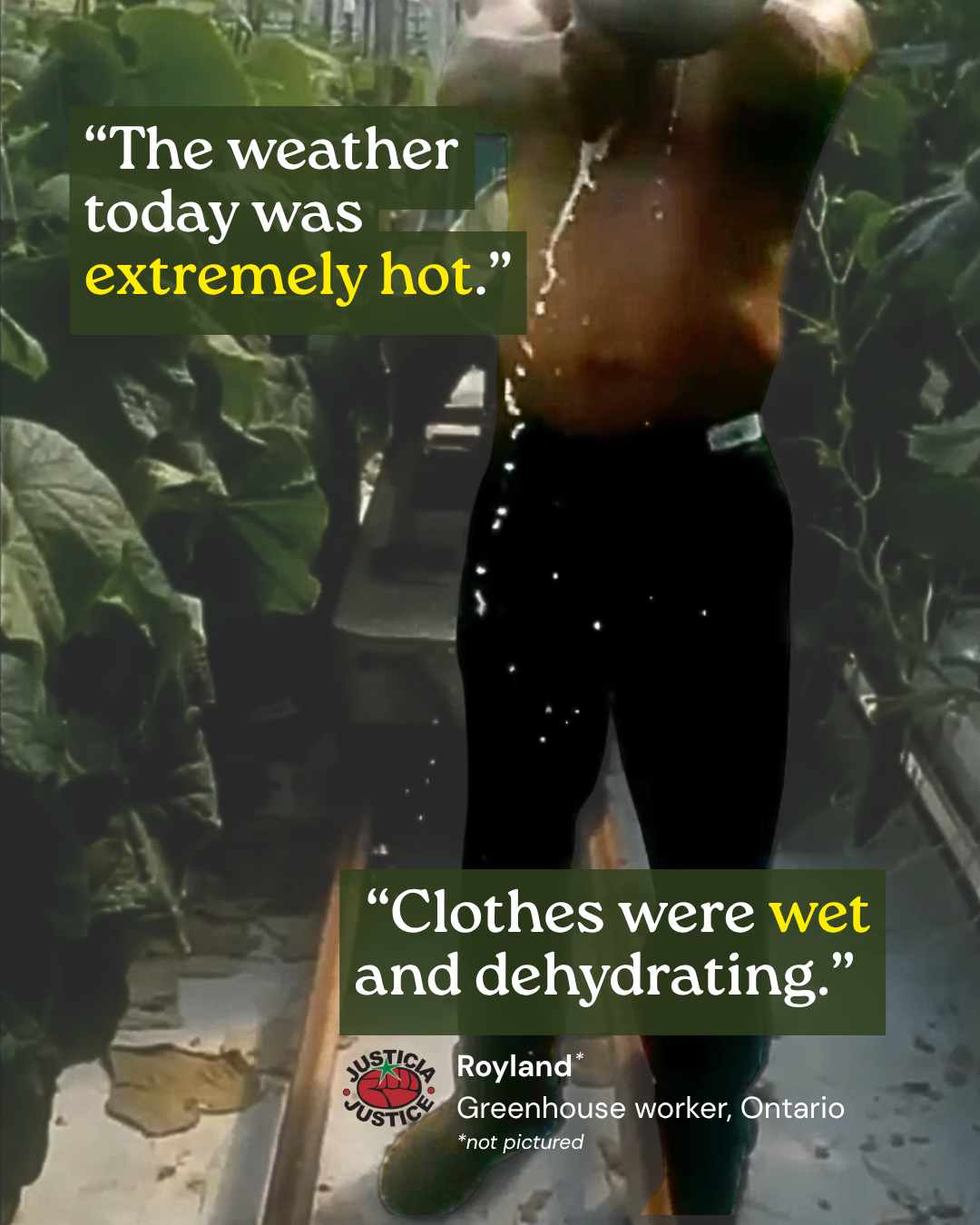
Every summer, our members tell us about the realities of working in extreme heat:
- Clothes drenched in sweat.
- Limited or no breaks or access to cold water
- Air conditioning that fails year after year.
- Workplaces shut down with no compensation for lost wages.
- Coworkers passing out.
- Chronic illnesses after years of exposure.
- Bosses that “just don’t understand” what it’s actually like to work in the heat.
Then there is the very real risk of death.
“Heat kills, and long before it’s fatal, it impairs cognition, increases fatigue,
Extreme Heat is Killing America’s Workers,
and increases the risk of accidents while driving direct physiological harm,
including heat stroke and organ failure.”
Groundwork Collaborative
In a recent statement to the Ontario Ministry of Labour, member Justice for Migrant Workers (J4MW) expressed “serious alarm at the recent deaths of at least 8 migrant farmworkers across Ontario in a period of a bit more than 30 days. These are only the deaths that have been reported to our organization, and we know they do not reflect the true number.”
Listen to J4MW’s full statement in Spanish:
These dangers exist across the entire food system — not just farmworkers, but warehouse workers, food manufacturing workers, restaurant workers and street vendors are all feeling the impacts of extreme heat. As with so many hazardous jobs, those facing the greatest risk are disproportionately low wage, immigrant, and Black and brown workers. According to the Washington Center for Equitable Growth, the lowest paid 20% of workers suffer five times as many heat-related injuries as the highest paid 20%.
The reality of legal protections in the U.S. & Canada
Many people don’t realize that in the U.S. there are no federal laws protecting workers from extreme temperatures. And in Canada, provinces like Alberta and Ontario (where J4MW is fighting for heat rules) have no specific standards. When specific standards are lacking, employers have no legal obligation to take action beyond the general duty clause to keep workers safe. That means:
- NO temperature thresholds that trigger increased breaks, workplace shutdowns, or specific cooling devices like air conditioning, fans or shade.
- NO training required for employers or workers on the dangers of heat stress, prevention, or how to spot the first signs of illness.
- NO hazard pay for increased risk, or compensation for lost wages due to shuttered workplaces or heat illness.
In the U.S., seven states have heat regulations, and only three of those — California, Maryland, and Oregon — protect both indoor and outdoor workers. Others have gone in the opposite direction: Texas and Florida actually prohibited local ordinances that entitled outdoor workers to mandatory water and rest breaks on excessively hot days.
The U.S. and all Canadian provinces need strong, enforceable, laws that apply to all workers — that means indoor workers, incarcerated workers, and guest workers too.
Outlook under Trump
In 2024, OSHA finally proposed a heat standard. For a while, it seemed that process has stalled indefinitely under the new administration. But the government recently indicated that they expect to issue a finalized standard by October 2027. We’ll have another summer of deadly heat before then. Workers need protections now.
Even in 2027, it’s extremely unlikely that a rule issued under the current administration would be sufficient, specific, or enforceable.
“All of the federal agencies have been gutted, and enforcement was lacking
Dominique O’Connor
before the current administration, so there are not a lot of positive feelings.”
Farmworker Association of Florida
At current staffing, it would take over 180 years for OSHA to inspect every workplace once (Death on the Job, AFL-CIO). On top of that, the existing directives that guide those inspections are weakening. A new heat NEP issued in April reversed recent progress, removing a goal to double heat inspections that had led to a dramatic increase: 7,000 inspections from 2022-2024, compared to 1,000 from 2015-2020. The new NEP also directed staff to prioritize inspections in response to fatalities, rather than taking a preventative approach.
“The root is the burning of fossil fuels. I don’t think corporations or
Edgar Franks
big companies are doing anything to stop the current crisis. So it’s up to
workers, because workers on the front lines — even in refineries or in all the
industries that work with fossil fuels — are also impacted by this.”
Familias Unidas por la Justicia
Workers are organizing
Here’s how FCWA members are organizing for the protections workers need:
- Laundry Workers Center member Karen told us that this summer, she and her coworkers told management that “if the heat keeps going, we will stop working.” As a result, “they hired a person who can come and check when the air is not working. So now we have gone like 3 days without air conditioning. In the past it was up to a week and a half.”
- Farmworker Association of Florida is providing the tools and training workers need to protect themselves and each other.
- Justice for Migrant Workers holds a yearly protest outside the Ontario Ministry of Labour to decry the agency’s inaction.
- Street Vendor Project just celebrated Mayor Mamdani’s Executive Order to protect NYC’s outdoor workers from heat illness.
- In 2024, Warehouse Worker Resource Center celebrated the success of their ten-year campaign pressuring California to extend existing heat standards to indoor workers.
- In 2023, Familias Unidas por la Justicia successfully pressured Washington to lower the trigger temperature for mandated shade, water, and paid breaks from 89° to 80°.
We can take action!
- Demand strong, specific and enforceable standards that apply to ALL workers in the U.S. and Canada — including incarcerated workers and guest workers.
- Stop the attacks on OSHA. We need it fully funded and fully staffed!
- Reject H.R. 6213, the misleadingly-named Heat Workforce Standards Act, which would prohibit the OSHA from creating or enforcing any national heat safety law. Dial 844-937-2517 or fill out the form on this page to share your opposition.
- Use the National Council on Safety and Health’s tools to file an OSHA complaint and educate workers on extreme heat.